GZbohangzhineng@163.com
+86-18675873677



Bottle Blowing Machines are central to modern PET packaging production, determining not only output capacity but also product consistency and manufacturing efficiency. Understanding the differences between fully-automatic and semi-automatic systems helps manufacturers choose the right solution for their production scale and operational needs. Both technologies shape PET preforms into finished bottles, yet they differ greatly in workflow, labor demand, control precision, and investment levels.
Bottle blowing machines use heat, stretching force, and compressed air to transform PET preforms into bottles used in water, beverages, edible oils, detergents, and industrial liquids. Regardless of the type, every machine follows a core process that includes preform heating, stretching, high-pressure blowing, shaping, and cooling. The major distinction lies in how each step is executed and how much human input is required.
Fully-automatic systems integrate every stage into a streamlined sequence, while semi-automatic machines separate some steps and require workers to assist in preform loading or bottle removal. This difference determines efficiency, cost structure, and suitability for different production environments.
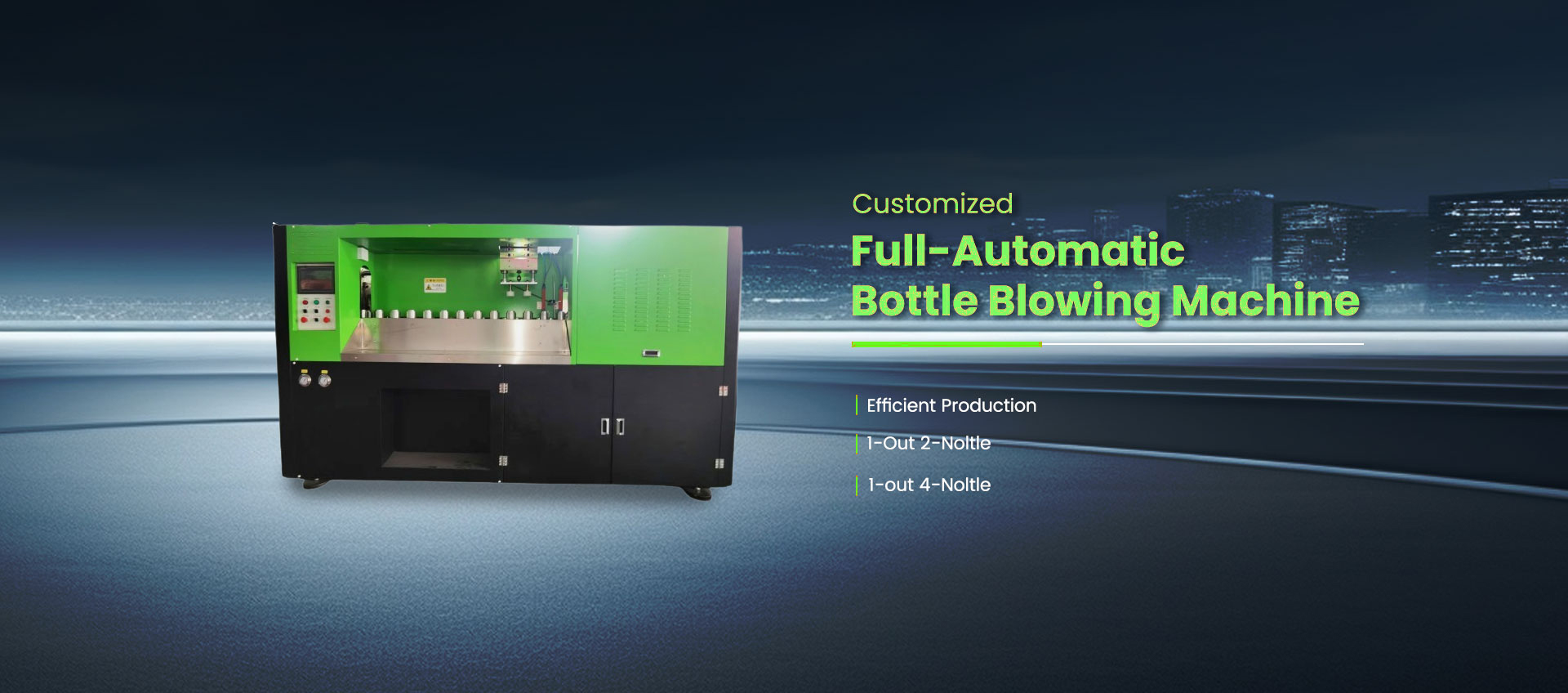
Fully-automatic bottle blowing machines are designed for high-volume industrial production. Preform feeding, heating, stretching, blowing, and bottle discharge are completed in one continuous cycle. The system synchronizes all operations through PLC control, greatly reducing manual involvement.
High Production Capacity Fully-automatic machines typically deliver fast cycles, ranging from thousands to tens of thousands of bottles per hour depending on the model. This efficiency makes them suitable for beverage factories, packaging lines, and large-scale operations.
Consistent Quality Output Because heating and blowing parameters are controlled centrally, the resulting bottle dimensions and wall thickness remain uniform. This is important for products requiring strict appearance and structural requirements.
Integrated Safety and Monitoring Sensors track temperature, pressure, and Mold position, reducing operational risks and preventing defects.
Lower Labor Costs Operators mainly supervise machine performance instead of manually handling preforms or bottles.
Higher Initial Investment Automation requires greater upfront cost but delivers long-term savings through reduced labor needs and stable production output.
Semi-automatic bottle blowing machines combine mechanical processes with manual involvement. Workers typically load preforms into the heating zone, then transfer heated preforms into blowing molds. Although cycle times are slower, the structure is simpler and cost is lower.
Suitable for Medium to Small Production Ideal for factories producing a few thousand bottles per hour or businesses with diversified bottle shapes that require frequent mold changes.
Flexible Operation Operators can adjust heating, stretching, and mold parameters more directly, making the machine suitable for customized or low-volume production runs.
Lower Initial Cost Investment is significantly lower because the automation components are simplified.
Higher Labor Requirement Workers manage multiple stages manually, which increases labor cost and may impact consistency.
Good for Testing and Development Many manufacturers use semi-automatic systems for sample making, pilot production, or frequent design adjustments.
| Feature | Fully-Automatic | Semi-Automatic |
|---|---|---|
| Labor requirement | Minimal | High |
| Production speed | Very fast | Moderate |
| Bottle consistency | Extremely stable | Operator-dependent |
| Initial investment | Higher | Lower |
| Ideal for | High-volume production | Small and mid-scale production |
| Automation level | Full integration | Partial automation |
| Mold change frequency | Optimized for long runs | Suitable for frequent changes |
The best machine depends on production goals, budget, and product requirements. Large beverage or packaging plants typically favor fully-automatic systems for efficiency and stability. Small manufacturers, startups, or those producing varied bottle shapes often prefer semi-automatic options because of their flexibility and affordability. Factors such as available factory labor, required throughput, and energy consumption also influence the choice.
For companies looking to upgrade or expand production, evaluating long-term operational costs is essential. While fully-automatic machines require a larger investment, they reduce labor dependency and improve output consistency, often delivering better cost performance over time.
Manufacturers seeking both fully-automatic and semi-automatic solutions can explore the equipment offered by JINBORUN. The company provides a variety of pet bottle blowing machines designed for durability, operational stability, and efficient output. Their engineering capabilities support high-performance production lines and customized requirements suitable for diverse packaging applications.
Fully-automatic and semi-automatic bottle blowing machines each serve different segments of the PET packaging industry. Understanding their operating principles, benefits, and limitations enables manufacturers to select the best technology for their production goals. With careful evaluation and the support of experienced suppliers such as JINBORUN, companies can build efficient and scalable bottle manufacturing systems.