GZbohangzhineng@163.com
+86-18675873677



PET bottle production looks simple on the surface, but the machine behind it is a tightly integrated industrial system built around heat control, motion control, air management, Mold precision, and repeatable automation. In modern PET bottle machine manufacturing, the goal is not only to make bottles fast, but to make every bottle stable in weight, wall distribution, clarity, and sealing performance across long production runs. PET stretch blow molding remains the core method for bottle production, with the machine typically organized around preform infeed, transfer, heating, molding, and bottle discharge modules.
For packaging plants, the way a machine is built matters as much as its rated output. A poorly integrated system may create unstable heating, uneven wall thickness, bottle deformation, air leakage, or excessive energy use. This is why how blow molding machines are made has become an important topic for buyers evaluating long-term production reliability rather than only initial purchase cost. At BOHANG, the company positions itself as a manufacturer focused on R and D, production, marketing, repair, maintenance, and installation of mechanical and intelligent equipment, while its bottle blowing range emphasizes servo systems, PLC control, automated operation, customization, and reduced downtime.
A pet bottle blowing machine is manufactured as a complete production platform rather than a single standalone frame. The engineering sequence usually starts from process definition. The manufacturer first determines target bottle volume, neck finish, cavity layout, cycle expectations, air demand, and compatibility with downstream filling and packing lines. From there, the machine architecture is divided into several coordinated sections that must work in exact timing.
The heating section is one of the most critical parts. Research on PET processing shows that injection molding of preforms typically occurs at 250 °C to 280 °C, while reheating before blow molding commonly brings preforms into the 100 °C to 110 °C range. Around 105 °C is often cited as the operating zone where PET can achieve the orientation needed for bottle formation. That means the machine manufacturer must design lamp layout, thermal shielding, transfer speed, and control logic together rather than as separate parts.
The forming section is built around two-direction deformation. Inside the mold, the preform is stretched axially by a rod and expanded radially by compressed air. This dual action creates the final bottle shape and strongly affects material distribution. Academic reviews note that unstable heating or poor control in this stage can directly reduce final product quality, which is why temperature control, air timing, and mold accuracy are central to industrial manufacturing of blowing systems.
In practical machine production, assembly, manufacturers normally move through a structured workflow from design to commissioning.
The base frame, guarding, transfer rails, heating carriers, clamping structures, and mold mounting interfaces are manufactured first. Structural rigidity is important because bottle molding is a fast cyclic process. Any vibration, misalignment, or weak mounting can affect mold closing accuracy and service life. BOHANG highlights the use of high-quality materials and strong tooling so equipment can withstand repeated production cycles with lower breakdown risk.
After the frame is prepared, the heating unit is installed. This includes infrared heating components, reflectors, thermal zoning, and preform transport. Good heating design is not only about reaching temperature, but about maintaining uniform temperature from one preform to the next. A 2023 study on intelligent control for stretch blow molding showed that automated control could keep preform surface temperature within plus or minus 2 of target temperature, which shows how narrow the control window can be in real production.
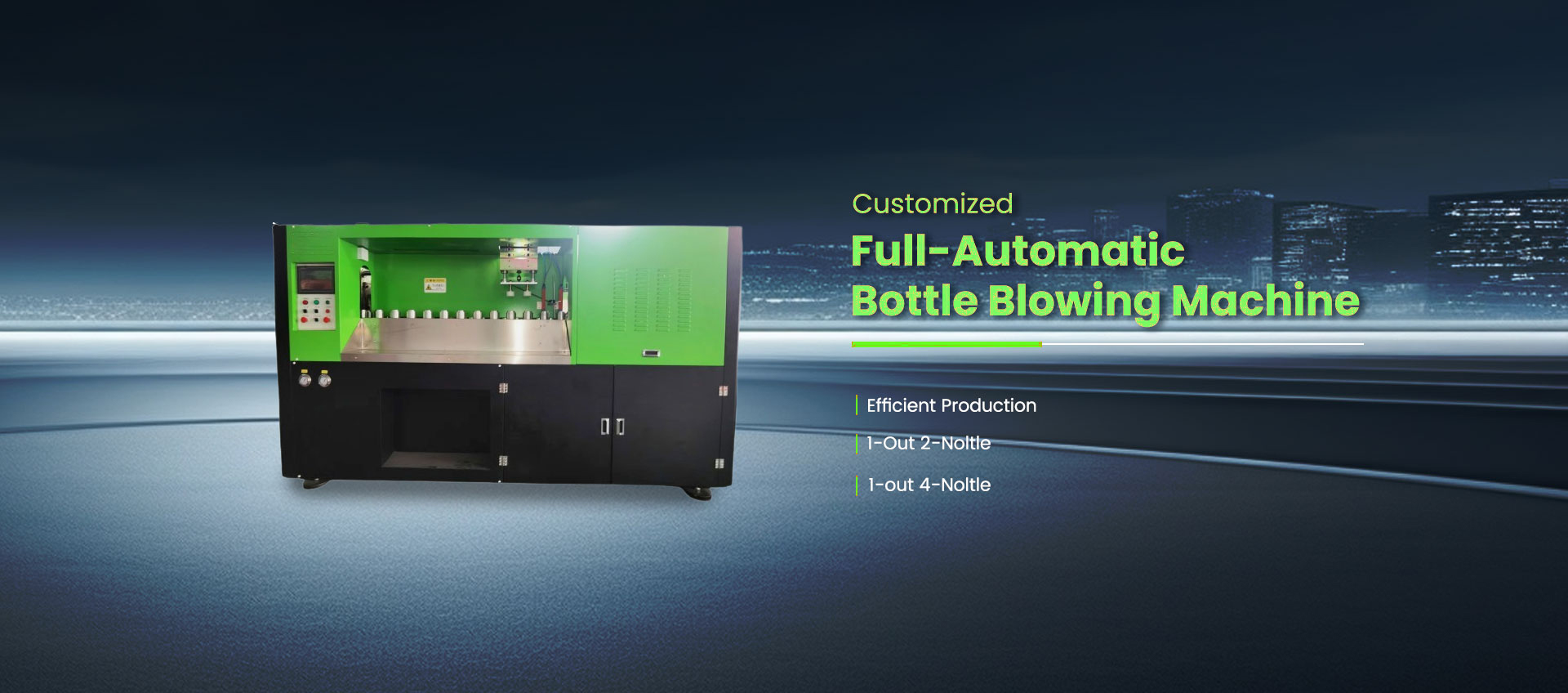
The next step is the blow station, including mold carriers, clamping mechanisms, stretch rods, pneumatic circuits, and high-pressure air routing. BOHANG describes its PET bottle blowing machine as a system integrating mechanical, hydraulic, pneumatic, and intelligent control technologies, enabling automatic operation from raw material heating to finished bottle output. In manufacturing terms, this integration is what separates a basic machine from a production-ready system.
The machine is then wired with PLC control, servo drives, sensors, touch screen interface, and safety logic. BOHANG states that its bottle blowing systems use servo motors, fast PLC systems, and automated controls to improve consistency and raise production output. For end users, this part determines recipe management, alarm response, parameter repeatability, and maintenance efficiency.
Before shipment, the machine must be tested for dry cycle stability, heating consistency, air response, mold movement, safety interlocks, and finished bottle output. In production environments, quality review often focuses on wall thickness consistency, dimensional uniformity, sealing integrity, and stable discharge. Because PET bottle quality is strongly influenced by the bottle manufacturing process itself, commissioning is not just a startup step. It is part of the manufacturing quality system.
| Manufacturing area | What must be controlled | Why it matters |
|---|---|---|
| Heating design | Preform temperature uniformity | Supports stable stretching and bottle clarity |
| Mold section | Clamping precision and cooling behavior | Affects shape accuracy and cycle repeatability |
| Air system | Pressure timing and clean delivery | Determines bottle formation and detail definition |
| Motion control | Servo and transfer synchronization | Reduces variation between cavities and cycles |
| Software | PLC logic and recipe repeatability | Improves changeover efficiency and process stability |
| Safety and service | Sensors, guarding, maintenance access | Protects uptime and simplifies daily operation |
The value of this control is growing because the PET packaging market is under stronger pressure to balance performance and sustainability. In the United States, PET bottle collection reached 33 percent in 2023, up from 29 percent in 2022, while average recycled PET content in bottles and jars rose to 16.2 percent. In Europe, PET collection reached 60 percent in 2022, the sorted-for-recycling rate for PET beverage bottles was estimated at 75 percent, and average recycled content in beverage bottles reached 24 percent. These shifts mean bottle producers increasingly need equipment that can handle tighter quality targets and more disciplined process control.
BOHANG’s website presents the company as a manufacturer with capabilities in development, production, installation, maintenance, and after-sales support. Its bottle blowing line covers automatic and semi-automatic PET systems, and the company emphasizes fast delivery, quality assurance, and ongoing service. For buyers, that combination is valuable because a blowing machine is not only a piece of equipment. It is part of a long production chain involving molds, air systems, bottle design, filling integration, and future maintenance.
The company also highlights modular adaptation, automated control, and production flexibility across bottle sizes and applications. That is important in PET bottle machine manufacturing because many factories need to switch between beverage, personal care, household chemical, and customized container formats without rebuilding the whole line. BOHANG also states that its machines are designed for high output, lower electricity use, easier maintenance, and long-term continuous operation.
The answer to how blow molding machines are made is not simply that components are assembled onto a steel frame. A true PET blowing system is manufactured through coordinated design of thermal control, air management, mold engineering, motion synchronization, software logic, and final commissioning. Every section affects bottle quality, operating cost, and line stability. That is why advanced machine production, assembly in this field requires both mechanical experience and process understanding.
For companies planning new bottle capacity or upgrading an existing line, the strongest machines are built with repeatability in mind from the first design step. BOHANG’s advantage lies in combining product development, manufacturing, automation, service support, and scalable PET equipment into one supply capability. In a market shaped by higher output expectations, stricter quality demands, and growing recycled material targets, that kind of integrated industrial manufacturing approach is what helps turn machine investment into dependable production.
Previous: